Wednesday, April 4, 2012

Snow in the forecast and these tomatoes don't care.

   Its going to snow again, but the tomatoes seem to be getting riper by the minute. Here are some pictures of a vine ripening over the last week.


March 30th


April 1st


April 3rd

April 4th

------------------------------------------------------

This plant was the first clone cut about two months ago. It had a head start on the other plants in the tubs, so it started forming fruit before the others. Now that the plants have been eating the flowering food for a week, they are beginning to form tons of flowers up and down every branch. 


Each flower will form a tomato if it is pollinated. The flowers only open for a few hours a day. In the wild, wind and insects pollinate the flowers. When growing tomatoes indoors, there may not be enough wind and hopefully not enough insects to pollinate the flowers effectively. The solution is simple, lightly flick the main stems while the flowers are open. Hard enough to shake the plant, but gentile enough to keep the stems from being damaged. When the flowers are pollinated, the flower will wither away and a small green ball will form at where the base of the flower was. When the flowers are pollinated the hard part is over. The buds will form into tasty tomatoes in about a month.

Tuesday, April 3, 2012

Peppers are Idealist

  
After ten days, the new sprouts are starting to show how much they are enjoying their ideal conditions. These mixed bell peppers(purple, yellow, red, green) sprouts were started and transplanted to containers at the same time. The containers are the same size.

   The only difference is one was grown under 20 hours of light with the room temperature around 75 degrees.


   The other was grown in the sunniest window in the house, dealing with cold nights and snowy days.

Tomato Update


   The tomatoes are also loving life. They were fed for the first time yesterday with a 3-1.25-1.25 fertilizer.  The food was mixed to a 1/4 strength so the plants don't get stunted. This happens because the new roots are very sensitive to nitrogen. The roots stop growing and die if exposed to too much. The plant will let you know if you have over-fed it, leaves will turn yellow at the tips and began to die back. If this happens, flush the container until water streams out of the bottom and don't feed again until the plant begins to recover.

Monday, April 2, 2012

Springtime in Montana


   This hydroponic tub was started about six weeks ago from tomato clones taken from a golden harvest (yellow cherry tomato) and a red cherry heirloom variety. The clones started slow because the roots need time to develope enough to be fully submerged in the nutrient solution. As the roots grow larger they can access the nutrients. Once the roots reach the nutrients the pants begin to grow very quickly.
 The plants also require more water as the roots develop. When the tub started, the plants did not need much attention. They now drink a gallon of fresh water daily and require constant pruning to make sure the leaves do not crowd each other. Over crowded plants can bring disease and spread insects from plant to plant, while reducing the amount of CO2 available to the leaves.
   This tomato started when the plant was about 12 inches. It ripened very slowly, maybe from the nutrient solution of because it was shaded at the bottom of the plant.

Meanwhile outside...

  After a week of unseasonal warmth, we began to prepare the outdoor raised bed.  The dirt in the bed is rock hard clay. It does not hold water well and seems to compact more and more after each rain. To help with drainage, coco fiber and small clay stones where added and worked in to around 24 inches. There were many roots growing very deep (16-24 inches) with small stems shooting toward the surface of the soil.  They were tilled up all the way to the bulb and thrown into the slash pile. 


   Then we were reminded why we are focusing on indoor farming...


Saturday, March 31, 2012

The Cat, The Grass, and The Wilderness

This is B.C. the farm cat. He stays inside the house year round because the normal wild life in Montana includes foxes, coyotes, wolves, bears and large birds that steal other cats in the area.


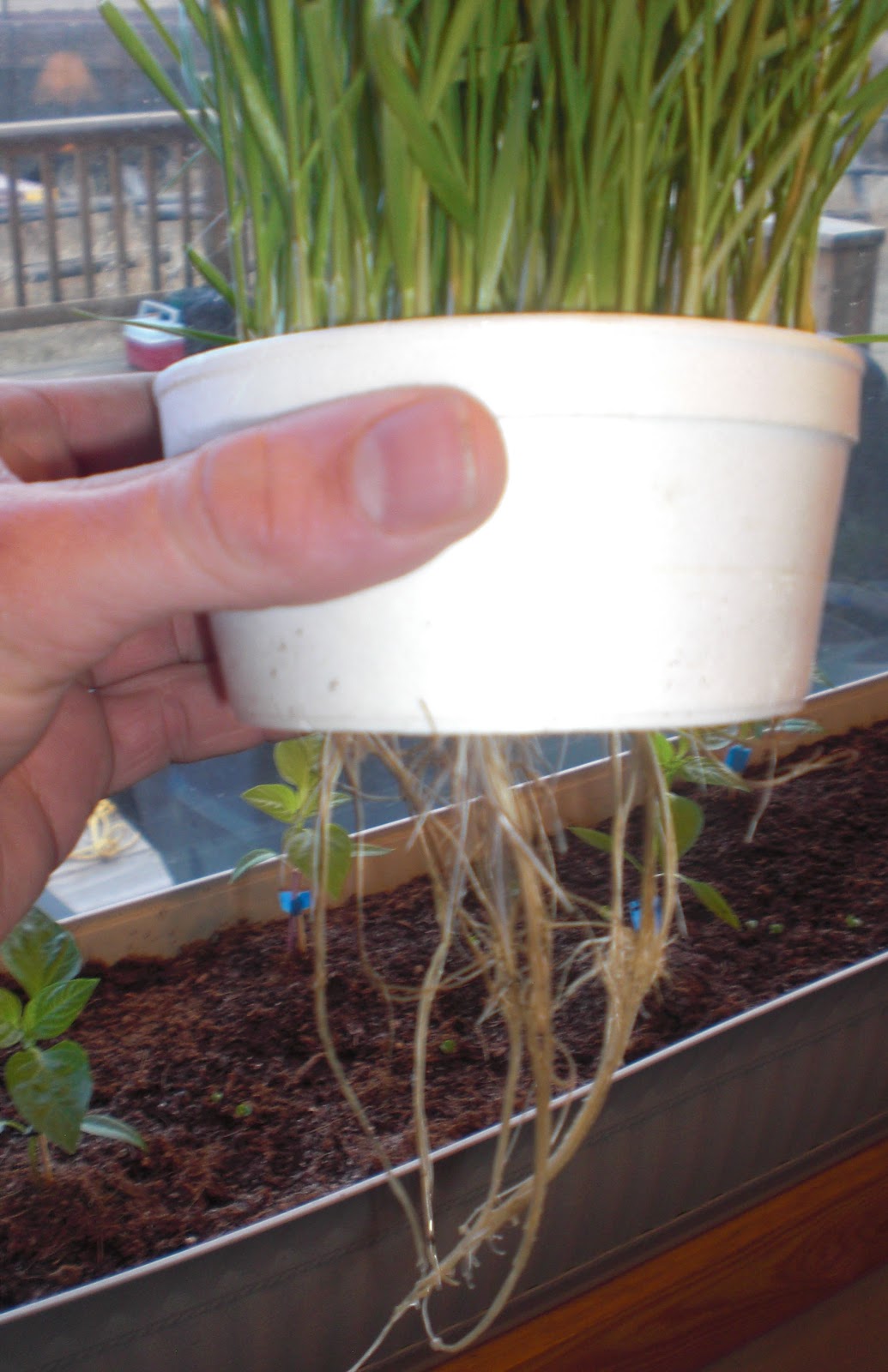
We grew him wheat grass to give him a taste of outside. It is very easy and he loves it. Seeds are widely available at health food stores and are inexpensive. 


A reused styrofoam container and red cup created a mini-hydroponic system. In less than 4 days we had a patch of cat grass that will last around two weeks. 


Friday, March 30, 2012

Montana is Cold

Small Scale Indoor Farm
   Farming in the mountains of Montana can be unpredictable. After losing the crops to late frost, early snowstorms, droughts, heatwaves, and the constant wind gusts that are common to the high altitude regions of southwest Montana, we decided to move the farm indoors. The Farm's goal is to produce year round, GMO free vegetables to the rural populations that surround us while remaining sustainable and earth friendly.  
   The Farm is focusing on growing rare heirloom varieties of tomatoes and peppers under artificial light. They are sprouted using a small 17watt flouresent light and rockwool cubes as a growing medium. The sterile rockwool cubes ensure that no bugs or disease are brought into the grow room. Here is a fresh Thai chili that just popped up...or two.
 
   The sprouts form roots rapidly, and the need to be transplanted with in a day or two to prevent the roots from getting damaged or turning green from being exposed to light. Coco Fiber is an excellent growing medium that is also sustainable. Instead of tearing through peat bogs that are habitat for numerous species and took thousands of years to form, the husk of coconuts is ground and compressed into a block. Like the rockwool, the coco comes sterile. After adding water the block expands into 16 gallons of medium. Adding organic fertilizer, such as fish emulsion or liquid seaweed, gives the block plenty of nutrients for the seedlings to flourish until their first feeding. Using the expanded coco the sprouts are transplanted into a 16 oz red cup to form a strong base of roots. The transplanted sprouts are put under a 48in flouresent shop light about 4 inches above the top of the plant.